Use the links below to go to the time period you are most interested in knowing more about:-
The Disaster...
THE Mexico Disaster of 1886
remains the worst tragedy in history, and had a significant
impact on global maritime safety and the procedures of the
then newly formed Royal National Lifeboat Institution (RNLI).
The Mexico was a:- 484 ton, 3 masted Iron Barque built in:-
1960, in Sunderland. Originally named the:- John Bull, she
had a long career in the Atlantic Trade before being sold to
German owners:- Oetling GebrÜder, and renamed. On 5 December
1886, the Mexico departed Liverpool bound for:- Guayaquil,
Ecuador, carrying a mixed cargo that included:- textiles and
machetes (some of which were later scavenged from the wreck
and remain in local Southport homes today). By 9 December
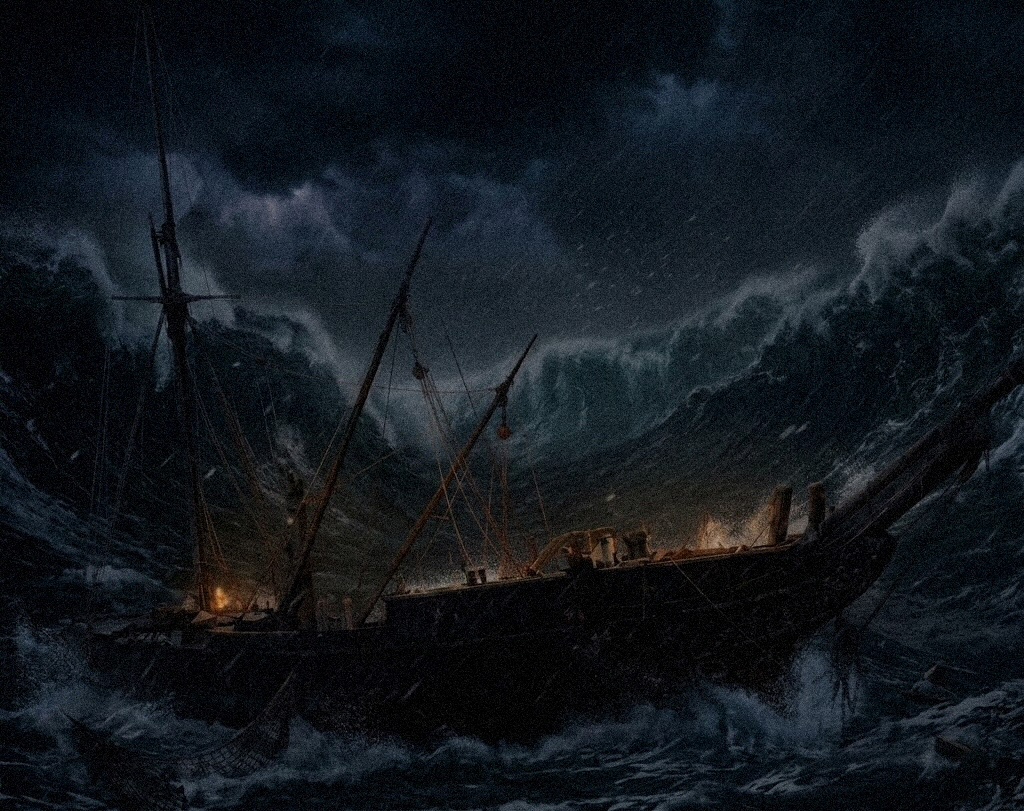
1886, she was caught in a violent West Northwesterly (WNW)
Force 7 to 9 Gale, eventually grounding on the Horse Bank in
the Ribble Estuary. The Horse Bank is a treacherous
sandbank, roughly:- 14 miles South of Southport's shoreline,
off both:- Ainsdale and Birkdale Beaches. Having struck the
Horse Bank sands, The Captain of the Mexico was Gustave
Burmester (sometimes spelled Burmeister in some historical
records) ordered the 12 man crew to immediately fire
distress rockets into the pitch black sky. These flares were
1st sighted by the lookout at the Southport Lifeboat House.
At 21:10, the Southport Sstation responded by firing a
mortar, the traditional signal to:- "assemble the
crew." Simultaneously, the heavy fog bell, located
at Southport Pier, began to toll a haunting, rhythmic signal
intended to guide the Lifeboatmen through the storm and
alert the Town to the unfolding emergency. The bell's
tolling served as a sombre backdrop as the volunteer crew,
largely consisting of local fishermen, abandoned their homes
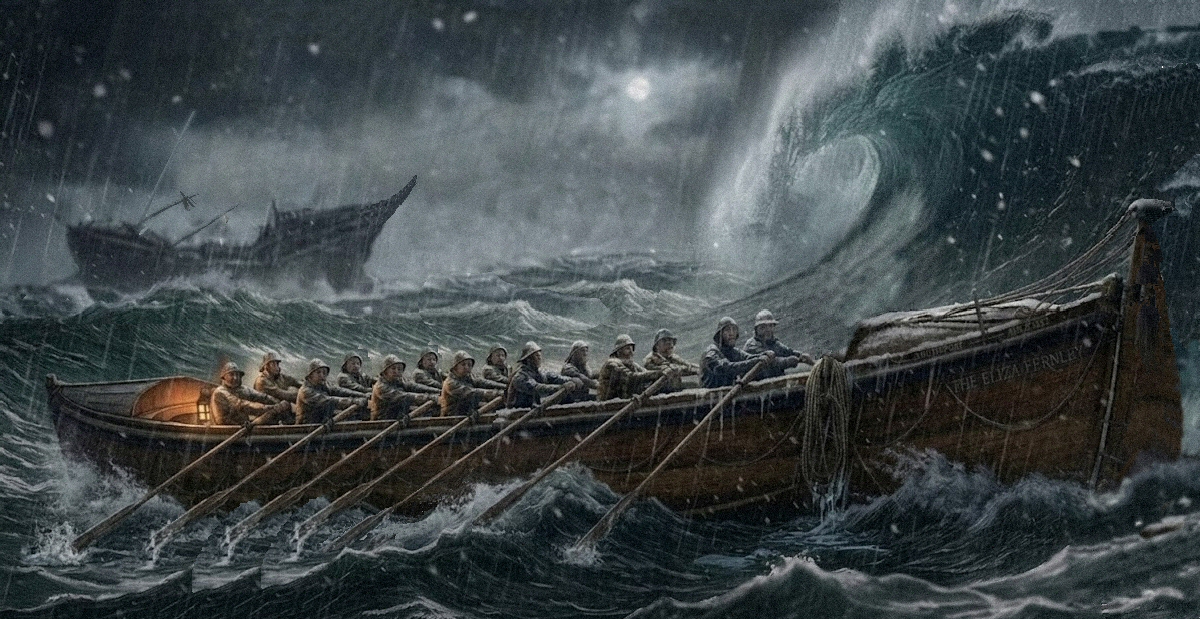
to head for the shore, to launch the Lifeboat, Eliza
Fernley.
By 21:15, the distress gun from:- St Annes Lighthouse, was
heard further up the coast in Lytham. The crew of the
Charles Biggs, under the command of Coxswain Joshua
Harrison, began their preparations. Meanwhile, at:- 22:25,
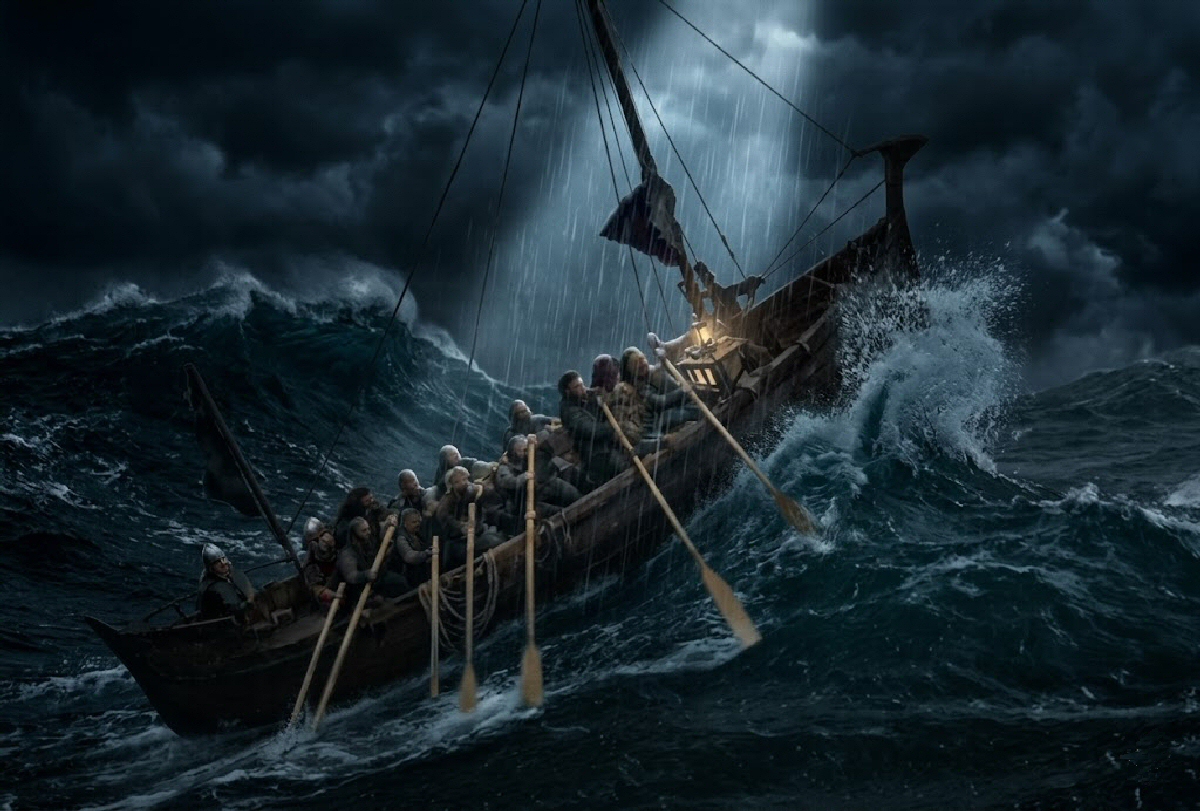
the Lifeboat:- Laura Janet, from St Annes, commanded by:-
Coxswain William Johnson, was launched into the mountainous
surf.
In Southport, the tide was too low for a direct launch. At
23:00, the Lifeboat Eliza Fernley was placed on its carriage
and hauled:- 3.5 miles along the shoreline by teams of
horses toward Ainsdale Beach. The crew, led by:- Coxswain
Charles Hodge, battled freezing winds and shifting sands for
nearly 2 hours before they reached a point deep enough to
launch.
The 1st success of the night occurred on:- 10 December 1886,
at:- 00:30. The Lytham Lifeboat, Charles Biggs, reached the
Mexico. In a display of extraordinary seamanship, Harrison
and his crew rescued all 12 men from the stricken Barque.
Unbeknownst to the other 2 stations, the mission was
technically complete after Gustave Burmester and watched his
11 crew members, who had been lashed to the timbers depart
the Mexico disembarked himself on to the Charles Biggs.
At 01:00, the Eliza Fernley neared the wreck site. As the
crew prepared to drop anchor and veer down toward the
Mexico, a massive:- "broken" wave struck the
boat broadside. The vessel capsized instantly. Because the
water was too shallow for the self-righting mechanism to
fully rotate, the men were trapped beneath the hull or swept
into the freezing surf. 14 men, including Coxswain Charles
Hodge, Benjamin Peters, and brothers Thomas and Richard
Robinson, were lost. Only Henry Robinson and John Jackson
managed to survive by finding a pocket of air beneath the
upturned boat and eventually clinging to the keel.
The fate of the St Annes boat, Laura Janet, remains a
mystery of the storm. It is believed she was overwhelmed at
roughly the same time, around:- 1:10. All 13 crew members,
including:- Coxswain William Johnson and Charles Tims,
perished without a single survivor to recount their final
moments.
By the 10 December 1886, the scale of the disaster became
clear. At 3:00, Henry Robinson and John Jackson reached the
shore at Birkdale, exhausted and near death. They raised the
alarm, and search parties were dispatched.
At 07:00, the Eliza Fernley was found washed up near Weld
Road, Birkdale. The bodies of the crew were recovered and
taken to the coach house of the Palace Hotel. Later that
morning, at, at:- 10:30, the Lytham crew, exhausted and
having safely landed the Mexico's survivors found the St
Annes boat, Laura Janet, drifting bottom up in the Ribble
Estuary.
The disaster devastated the tight knit fishing communities
of the Lancashire coast. In Southport, 10 of the crew came
from:- Ecclesfield, where family ties were the backbone of
the service. The 27 men lost that night left behind a
community in mourning, including:- 16 widows and 50 orphans.
The disaster remains the deadliest in RNLI history. Today,
the Southport Offshore Rescue Trust maintains the legacy of
these men, operating as an independent station. The names of
the fallen are etched into memorials across the 3 Towns, and
the tolling of the fog bell
remains a symbol of the night the Lancashire coast stood
still.
The disaster remains a case study in Victorian maritime
engineering. While all three boats were:- "pulling and
sailing" Lifeboats, subtle design differences proved
fatal. This lead to a rethink about how Lifeboats should be
made and also lead to safer boat designs in general.
Eliza Fernley (Southport) - Capsized; failed to right in shallow water. 14
crew lost.
Laura Janet (St Annes) - 3Overwhelmed and found bottom up. 13
crew lost.
Charles Biggs (Lytham) - All
crew safe. Successfully rescued all 12 crew from Mexico.
It is worth adding that in 1891, in response
to the tragedy, the 1st Lifeboat Saturday was held within the
English City of Manchester, organised by Manchester'
industrialist:- Sir Charles Macara and his wife Marion. They
were moved by the plight of the families organised the World's
1st organised street collection for charity. Both of them
realised that this vital service run by the newly formed RNLI
could no longer depend solely on wealthy patrons. The event, we
are told from reports at the time, included both bands and
Lifeboats parading through the streets of Manchester as
volunteers collected:- "pennies from the masses."
This model doubled the RNLI's income within 10 years and is the
direct ancestor of modern:- "Flag Days." The most
significant legacy was the birth of modern fundraising, that we
all know thought the world today!
Audio Rendition...
This is our very moving musical saga, a retelling /
musical rendition of the events that took place that
frightful night.
The Lifeboats...
To understand why this was a turning
point in RNLI and all maritime lifeboat building and
engineering it is vital you understand why 1 lifeboat
survived while 2 failed. So why did the Lytham Lifeboat
survive? According to RNLI records from the time of the
incident indicates that the Charles Biggs was on her maiden
voyage. She was a:- "Watson Class" boat, so
critically, she was fitted with 4 water ballast tanks. These
tanks provided superior stability in the shallow, turbulent
waters of the Ribble Estuary, and the Mersey Bay, compared
to both the:- Southport and St Annes boats, which relied on
older self righting mechanisms that ultimately failed in the
Force 9 Gales.
Peake Class...
Eliza Fernley (Southport): 34ft
Peake Class - Relied on a heavy iron keel and air boxes.
In shallow water, the boat hit the sandbank while upside
down, preventing the lifeboat from performing a:-
"self righting" motion.
Laura Janet (St Annes):
34ft Peake Class - Relied on a heavy iron keel and air
boxes. In shallow
water, the boat hit the sandbank while upside down,
preventing the lifeboat from performing a:- "self
righting" motion.
(Scroll Left to Right -> )
Feature
Peake Class (Self Righter)
Watson Class (Stable)
Design Philosophy
Designed to capsize and flip back over (Self righting).
Designed to be too wide/heavy to capsize (High stability).
Width (Beam)
Narrow (approx. 7ft 6in) for easy beach launching.
Wide (10ft+) for better
"footing" in heavy seas.
Ballast System
Used Cork and Iron keels for permanent buoyancy.
Used Water Ballast Tanks (filled after launching).
Main Vulnerability
Unstable in shallow"broken" water (Horse Bank).
Heavier and slower to move by oar.
Materials
Double-diagonal Mahogany with Copper Air Cases.
Mahogany on Oak with Iron Keel.
Note: You can drag the bottom-right corner of this box to resize the table width manually.
Watson
Class
Charles Biggs (Lytham):
34ft Watson Class - Relied on Water Ballast Tanks.
The wider beam and ballast tanks provided a lower centre
of gravity, preventing the capsize entirely.
(Scroll Left to Right -> )
Component
Material
Purpose
The Hull (Skin)
Honduras Mahogany
Highly durable and rot-resistant. The straight
grain prevented the wood from splitting when
smashed against wrecks or rocks.
The Framing (Ribs)
English Oak
Provided the rigid:- "skeleton"
needed to maintain the boat's shape during Force
9 gales.
The Keel (Base)
Iron
A massive weight at the very bottom that lowered
the centre of gravity to prevent the boat from
capsizing.
The Fastenings
Copper
Unlike iron nails, copper does not rust in
saltwater, ensuring the hull remained watertight
for decades.
Air Cases
Galvanised Iron
Internal buoyancy tanks tucked under the deck
that kept the boat afloat even if it was
completely flooded
Note: You can drag the bottom-right corner of this box to resize the table width manually.
lost Crews...
Coxswain Charles Hodge
(SouthportEliza Fernley)
Background:- A highly respected fisherman from the Banks
area, Hodge was an experienced mariner who had led many
successful rescues.
The Action: He led the gruelling 3.5 mile land haul of the
Lifeboat to Ainsdale. Under his command, the crew launched
into the surf despite the exhaustion of the journey.
The Fate: Hodge was lost when the Eliza Fernley capsized
near the wreck. His body was recovered near the boat the
following morning. He was 49 years old and left behind a
widow and several children.
Coxswain William
Johnson
(St Annes - Laura Janet)
Background:- Known for his bravery and deep knowledge of the
Ribble Estuary's shifting sands.
The Action: Johnson commanded the Laura Janet on a 10 mile
pull through the storm. Because there were no survivors from
his boat, his final commands remain unknown, but it is clear
he pushed the crew to the absolute limit to reach the
Mexico.
The Fate: Perished along with his entire 12 man crew. He was
35 years old. His death, and the loss of the entire St Annes
crew, nearly ended the fishing industry in St Annes, as so
many experienced men were lost at once.
Coxswain Joshua
Harrison
(Lytham - Charles Biggs)
Background:- A veteran of the Lytham station, Harrison was
chosen to lead the maiden voyage of the new Watson-class
boat, the Charles Biggs.
The Action: Harrison's leadership is credited with the
successful rescue of the 12 sailors from the Mexico. He
managed to hold the boat steady against the wreck despite
losing three oars to a squall.
The Fate: Harrison survived the night and was hailed as a
hero. However, he remained deeply affected by the loss of
his colleagues in Southport and St Annes for the rest of his
life.
Eliza
Fernley (Southport)
Charles Hodge (Coxswain)
Ralph Peters
Benjamin Peters
Thomas Jackson
Peter Jackson
Timothy Rigby
Thomas Rigby
Thomas Robinson
Richard Robinson
John Ball
Henry Hartley
Peter Wright
John Wright
Harry Rigby
Laura
Janet (St Annes)
William Johnson (Coxswain)
Charles Tims
James Dobson
Thomas Bonney
James Bonney
Neil Harrison
Thomas Harrison
Richard Fisher
James Harrison
Herbert Harrison
John Wignall
James Parkinson
James Johnson
Timeline
(Scroll Left to Right -> )
21:00Distress signals fired by Mexico. Sighted by Southport lookout.
21:10Southport fires mortar. Fog bell at Southport Pier begins to toll.
21:15Distress gun from St Annes Lighthouse heard in Lytham.
22:25Lifeboat Laura Janet (St Annes) launched into mountainous surf.
23:00Eliza Fernley hauled 3.5 miles by horses to Ainsdale Beach.
00:30Lytham Lifeboat Charles Biggs reaches Mexico. Rescues all 12 men.
01:00Eliza Fernley capsizes near wreck. 14 men lost; 2 survive.
01:10Laura Janet overwhelmed; all 13 crew members perish.
03:00Henry Robinson and John Jackson reach shore at Birkdale.
What happened to the Mexico?
It is a common misconception that
the Mexico was destroyed during the storm. It is documented
that the Mexico had remained grounded on the Horse Bank, was
deemed salvageable. According to RNLI records, the Mexico
was salvaged and repair, 3 months after the disaster, in
March 1887. The wreck was reported to have been sold to a
Preston based firm for the remarkably small sum of:- £45.
According to historical records she was then successfully
refloated and towed to Preston Docks for extensive repairs.
Despite the violence of the storm, her iron hull had
remained largely intact.
For the following 2 years it is documented that he ship
became a morbidly popular tourist attraction, between:- 1887
to 1889, after being moored off Lytham Pier and opened to
the public as a:- "show ship."
The publicity the tragedy had gained drew thousands of
members of the public, all paying a small fee, to board the
vessel and see the rigging where Captain Burmester and his
crew had lashed themselves to survive the night. The money
raised from these visits often contributed to the relief
funds for the widows and orphans of the Lifeboatmen.
After her short time as a tourist attraction, the Mexico was
sold again and returned to her original purpose as a working
cargo vessel. She resumed international trade, including:- a
documented long distance voyage to the:- Falkland Islands
and back to London, in 1899, when she was renamed.
Her renaming to:- 'Valhalla'from Norse
mythology would not save her from the clutches of the sea.
The ship's long and troubled career finally ended 14 years
after the Southport tragedy, on:- 2 February 1900. Whiles
operating in another storm in Scottish waters, She struck
the rocks known as the:- Ox Cars, situated just below the
cliffs of:- Tantallon Castle, near North Berwick, Scotland.
All 12 crew members on board were taken off the ship safely,
by the:- North Berwick Lifeboat. There were no casualties
among the shipwrecked crew or the Lifeboat volunteers. Sadly
she was a totally wrecked. Unlike the catastrophic tragedy
at Southport 14 years earlier, her final wrecking did not
result in any deaths, but it marked the definitive end of
the ill fated Barque.
Today, the site near Tantallon Castle is a known spot for
local divers, though very little of the original structure
remains due to the shallow, high energy environment of the
coastline.
What was a Barque?
This type of ship (an Iron Barque) (often
spelled:- "bark" in American English) was a
type of deep water sailing vessel that became the workhorse
of global trade during the late:- 19th Century. They were
not built for speed like the famous Tea Clippers; as they
were built for economy, featuring a hull constructed from
iron plates riveted to an iron frame, unlike earlier ships,
which were built entirely of wood. Iron hulls were thinner
than thick oak timbers, providing more internal space for
bulky cargo like:- coal, grain, or wool.
This transition marked a significant shift in maritime
technology, thus allowing for larger, stronger, and more
durable ships. Because their rigging required fewer sailors
to manage, they were cheaper to operate. They dominated
the:- "pink batts" and:- "bulk"
trades until the early 20th Century, when steamships finally
became efficient enough to replace sail power entirely. As
these ships did not suffer from rot or wood boring
shipworms, meant they could stay at sea for longer periods,
and withstand the immense strain of larger masts and heavier
sail loads. The construction mean these ships to navigate
the rough waters, like the extream weather of Cape Horn,
more reliably and safely.
The defining feature of a Barque is its specific rigging
plan:-
3 or more masts... Most Iron Barques had
3 masts, though some had:- 4 or 5.
Square rigged foremasts... The forward
masts carried square sails, which were excellent for
catching the wind from behind during long ocean crossings.
Fore and aft rigged mizzenmast... The
rear mast (the mizzen) carried a:- "spanker"
sail (similar to a modern yacht sail). This made the ship
easier to steer and required a smaller crew than a fully
square rigged ship.
f you want to see a surviving example of an
Iron Barque, the most famous is the James Craig, an iron hulled
Barque built in:- 1874, that has been fully restored in:-
Sydney, Australia. She is now 1 of only 4 operational 19th
Century tall ships in the world, and frequently sails on public
experiences, from the Port of Sydney.
What is a Force 9 Gale?
Today a Force 9 on the Beaufort scale is
often the threshold for issuing a:- "Strong Gale
Warning" in maritime forecasts. These wind have
speed of:- 47 mph to 54 mph (or 41 knots to 47 knots / 75
km/h to 88 km/h). At this speed, on land, they can cause
slight structural damage, such as:- roof shingles blowing
off, and large branches break off trees. For shipping
though, these Gales present significant dangers, with most
small to medium vessels avoid going out entirely, as
maintaining control and stability is extremely challenging.
These winds t see often come with high waves that can range
from around:- 7 meters to 10 meters (23 feet to 32 feet) and
dense streaks of foam. For any vessel these conditions are
considered dangerous, particularly for a vessel like the
Mexico, in an area with torturous sandbanks, as steering
(broaching), is difficult and, in some cases, causing
vessels to be blown off course and hit sandbanks and
grounding. Not only that but the dense foam and spray
generated by the wind can significantly reduce visibility,
making navigation harder. These conditions also increase the
risk of rigging and mast damage from the wind, potential for
the waves can cause dangerous rolling leading to capsize,
injuries from falling objects, and the potential for crew
members to be swept overboard, and crew exhaustion. That is
not include the potential for sinking from taking on water,
due to waves crests crashing water onto the decking and from
roll over from cargo shifting violently. And, that is just
the start of the problems the crews of all the Lifeboats and
the Mexico faced that night! Even today, most Ports,
including Liverpool's Port, operations can be interrupted,
with guidance indicating that vessel movement should not be
undertaken within a port or harbour when wind speeds exceed
40 knots (Force 9).
Did You Know?
At the time of the incident, like the
City of Liverpool, the Ribble Estuary was part of the
Lancashire Coastline, but is now part of the Merseyside
Coastline, on the Southport side of the Ribble and the
opposite side, Lytham St Annes, remains within Lancashire
today.
Valhalla is a majestic, shield roofed hall in Asgard ruled
by the Norse god Odin, where half of the warriors slain in
battle (the einherjar) live, fight daily, and feast nightly
in preparation for Ragnarök. Chosen by Valkyries, these
warriors enjoy eternal life, healing daily, and consuming
endless mead and meat from the boar SæhrÍmnir.
Today, the Merseyside coastline is still the Merseyside
coastline, particularly in the Sefton area, is still
considered 1 of the most dangerous in the UK due to its
rapidly shifting, soft mud and strong tides, leading to
regular rescue incidents.
Related Pages
Charles
Livingston Disaster
Liverpool Bay Lifeboats
Liverpool Bay Pilots
Light Vessels (Light Ships) Liverpool Bay's Fog Horns and Fog
Bells
World 1st Lifeboat Station
Southport Lifeboat (SORT)
Our aim is to provide you
not only the current news, but also to help
promote our local areas diverse and rich history,
our innovative businesses, along with our amazing
culture. But we can only do this with your help
and support though advertising. fine out how
you can get your business advertised on here and
help keep our news services free to access.
(+44)
08443244195 Our
News Room Office Address Southport and Mersey Reporter, 4a
Post Office Ave,
Southport, Merseyside, PR9 0US, UK
Calls will cost 7p per
minute, plus your telephone company's access charge. Calls to this number may
be recorded for security, broadcast, training and record
keeping.